

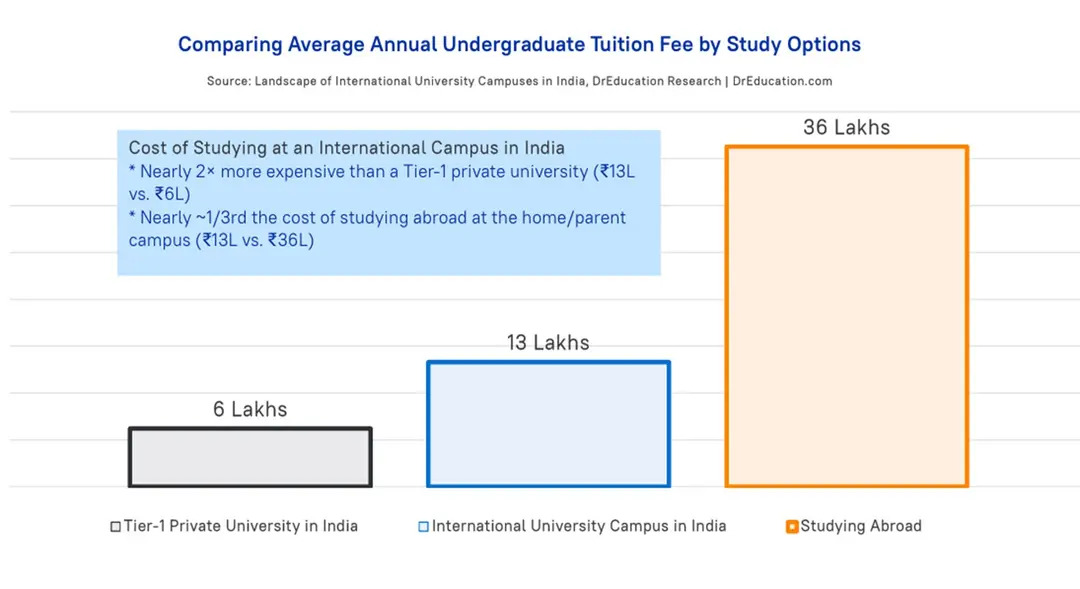
Hyderabad, Telangana, India, July 27, 2026 – One of the key aspects of international campuses’ positioning in India is that they offer an affordable pathway to earning a global degree. To quantify this, DrEducation Research compared average first-year undergraduate tuition fees at the 11 universities offering undergraduate degrees in India against average first-year fees at a select set of Tier-1 private universities in India, and against fees for studying abroad at the same universities’ home/parent campuses. This comparison excludes the added gap in living and travel costs, which makes studying overseas even more expensive.
The analysis found that, in terms of investment required, international campuses sit between Tier-1 private universities and studying abroad, though closer to the former. Specifically, studying at an international campus costs more than twice (115%) as much as a Tier-1 private university, but only about a third (36%) of the cost of studying abroad at the home/parent campus.
The report, “Landscape of International University Campuses in India 2026,” by DrEducation Research provides the first data-rich analysis of the 91 total programmes on offer for 2026–27 by 13 foreign universities. This report takes a deep dive into programme offerings, academic rankings, and tuition fees: United Kingdom (7) — University of Aberdeen, Birkbeck-University of London, University of Bristol, University of Liverpool, Queen’s University Belfast, University of Southampton, University of York; Australia (5) — Deakin University, University of New South Wales (UNSW), Victoria University, The University of Western Australia (UWA), University of Wollongong; and United States (1) — Illinois Institute of Technology.
This information is intended to help students, parents, and counsellors understand the fast-growing landscape of foreign university campuses in India and choose with clarity.
The National Education Policy 2020, along with subsequent regulations from IFSCA in GIFT City and the UGC, permits foreign universities ranked in the world’s top 500 to open campuses in India. At least 20 such universities have signalled interest. While this report focuses on 13 universities that are admitting students for 2026–27, the next edition of the report will include additional campuses at various stages of approval or announcement: United Kingdom — Coventry University, Lancaster University, University of Surrey; Australia — Flinders University, La Trobe University, Western Sydney University; and Italy — Istituto Europeo di Design. This will expand the universe covered by the DrEducation UniGrid™ in the next edition.
Why the Cost of Studying at an International Campus in India Is Perceived to Be Higher
Dr. Rahul Choudaha, Managing Director of DrEducation Research and author of the report, explains:
“International universities are coming to India at a time when barriers to study abroad are becoming higher and opportunities for post-graduation work are shrinking. However, the cost of studying at international campuses also needs to be put in perspective and quantified, so that families and students can make informed choices. Right now, there are limited ways to evaluate and compare these universities — they are very new, the information available is highly inconsistent, and some key expectations, particularly around placements, are simply not yet tested. As the data from DrEducation Research shows, even though studying at the international campus of a foreign university is a lot more economical than studying abroad, it is neither a replacement nor a replication of the immersive study abroad experience. The cost of education needs to be put in perspective of the benefits and value. Currently, with the unknowns of placement outcomes, the perceived cost of studying at international campuses seems to be higher, resulting in many parents and students being in a ‘wait-and-watch’ situation.”
How UniGrid™ Helps Understand International Universities in India
DrEducation UniGrid™ is a transparent, structured framework built specifically to support informed choices that are supported by data. Using this proprietary framework, this report classifies and compares international university campuses operating in India. UniGrid™ plots universities on two axes — academic ranking and total tuition fee — and groups them into four easy-to-understand segments:
• MAXIMISER — better ranked, lower tuition fee
• PREMIER — better ranked, higher tuition fee
• ECONOMISER — lower ranked, lower tuition fee
• EXPLORER — lower ranked, higher tuition fee
Alongside an interactive, visual dashboard on the DrEducation website, a best-fit quiz helps students identify what they prioritize among various factors — such as tuition fee, location, field of study, programme duration, and university ranking — and see which campuses match. This brief quiz provides a personalised set of international campuses that may fit a student’s needs.
