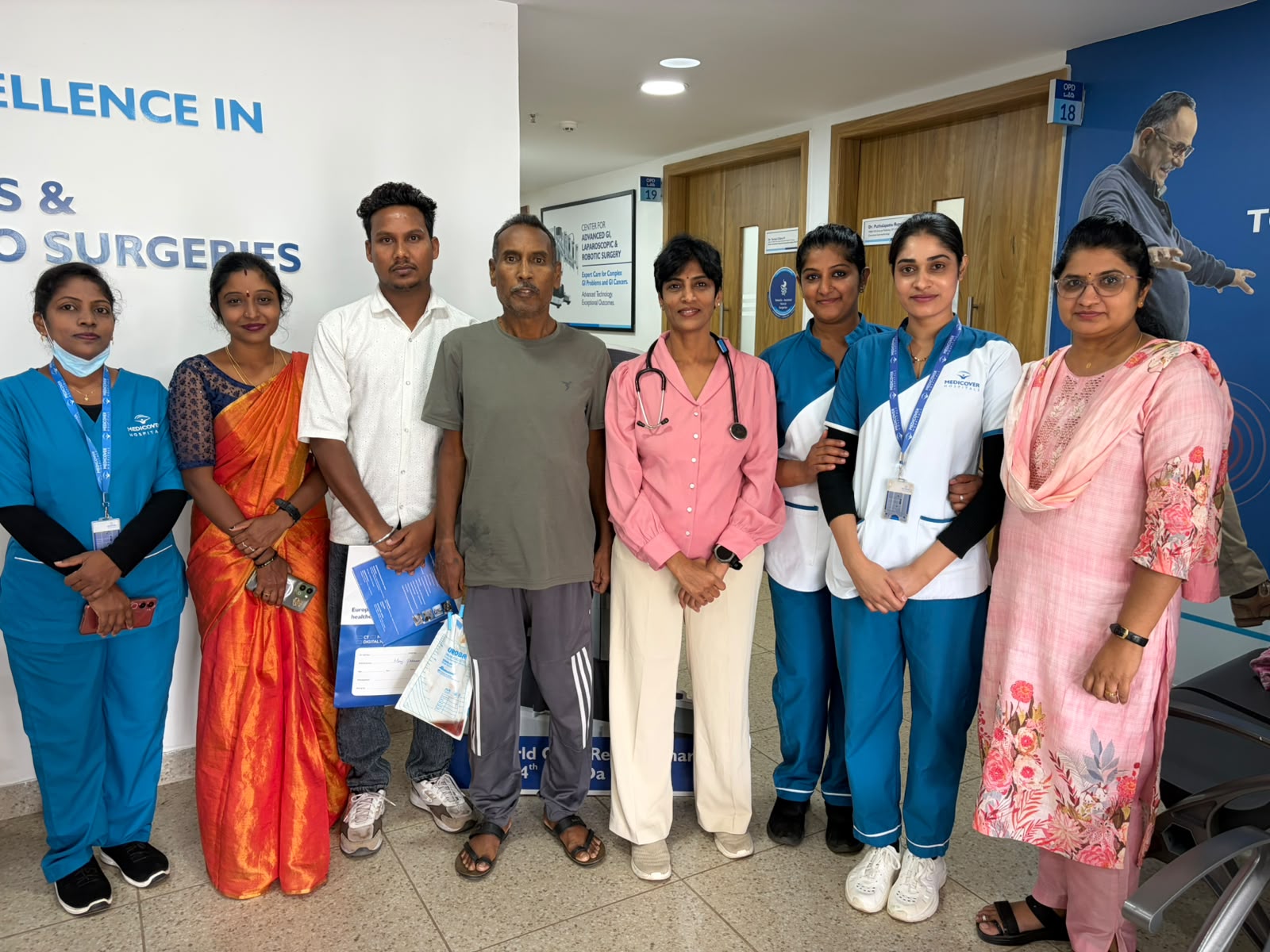
Bengaluru: Surgeons at Medicover Hospitals, Hoodi, Bengaluru, have treated a 54-year-old man with severe obstructive jaundice who had been advised elsewhere that he most likely had a cancerous tumour near the bile duct. The actual cause turned out to be Type 1 Mirizzi syndrome, a rare condition in which gallstones compress the main bile duct from outside, complicated by a pus-filled gallbladder.
The patient, a native of West Bengal, had suffered pain in the right upper abdomen for nearly three months and worsening jaundice for a month. His urine had turned dark and his bilirubin had risen to 22 mg/dL, against a normal upper limit of about 1.2 mg/dL. He had been told that surgery would be extremely risky.
At Medicover, a CT scan and Magnetic Resonance Cholangiopancreatography (MRCP) showed a complete block in the upper bile duct, multiple large gallstones and a soft-tissue mass near the duct. Bile duct cancer was the working diagnosis going into surgery.
During the operation, however, the team led by Dr Yamini Chitra V., Senior Consultant Surgical Gastroenterologist and GI Oncologist, found that the gallbladder had turned into a large abscess containing about 100 ml of pus and more than 40 stones. The stones were pressing on the main bile duct from outside, blocking bile flow completely. No stones were found inside the duct itself, but its wall had thickened from months of inflammation and pressure.
The team removed the gallbladder, cleared the pus and stones, and performed a Roux-en-Y hepaticojejunostomy, joining a loop of small intestine directly to the bile duct to create a new channel for bile to drain into the intestine.
The first 48 hours after surgery were critical. The liver had been under severe strain and bile production had nearly stopped; maintaining kidney function, blood pressure and urine output required close coordination between the surgical team, anaesthesiologists, intensive care specialists and nursing staff. Bilirubin fell from 22 to 14 mg/dL by the fourth day, then to 9 mg/dL, and returned to normal within two weeks. The patient was eating and walking by the sixth day and was discharged in stable condition.
“With a bilirubin of 22, cancer was the strong possibility on every scan. What we found instead was a rare Mirizzi syndrome, with gallstones compressing the bile duct from outside,” said Dr Yamini Chitra V. “Had he come three months earlier, this would have been a routine laparoscopic or robotic gallbladder removal. The delay caused infection, pus formation, thickening of the bile duct and life-threatening jaundice.”
“Not every jaundice is cancer, and not every jaundice can be treated with herbal medicines or home remedies,” she added. “Jaundice can be caused by bile duct obstruction, gallstones or other serious conditions that need surgery. Anyone who notices yellowing of the eyes or skin, dark urine or pale stools should see a specialist immediately rather than wait.”