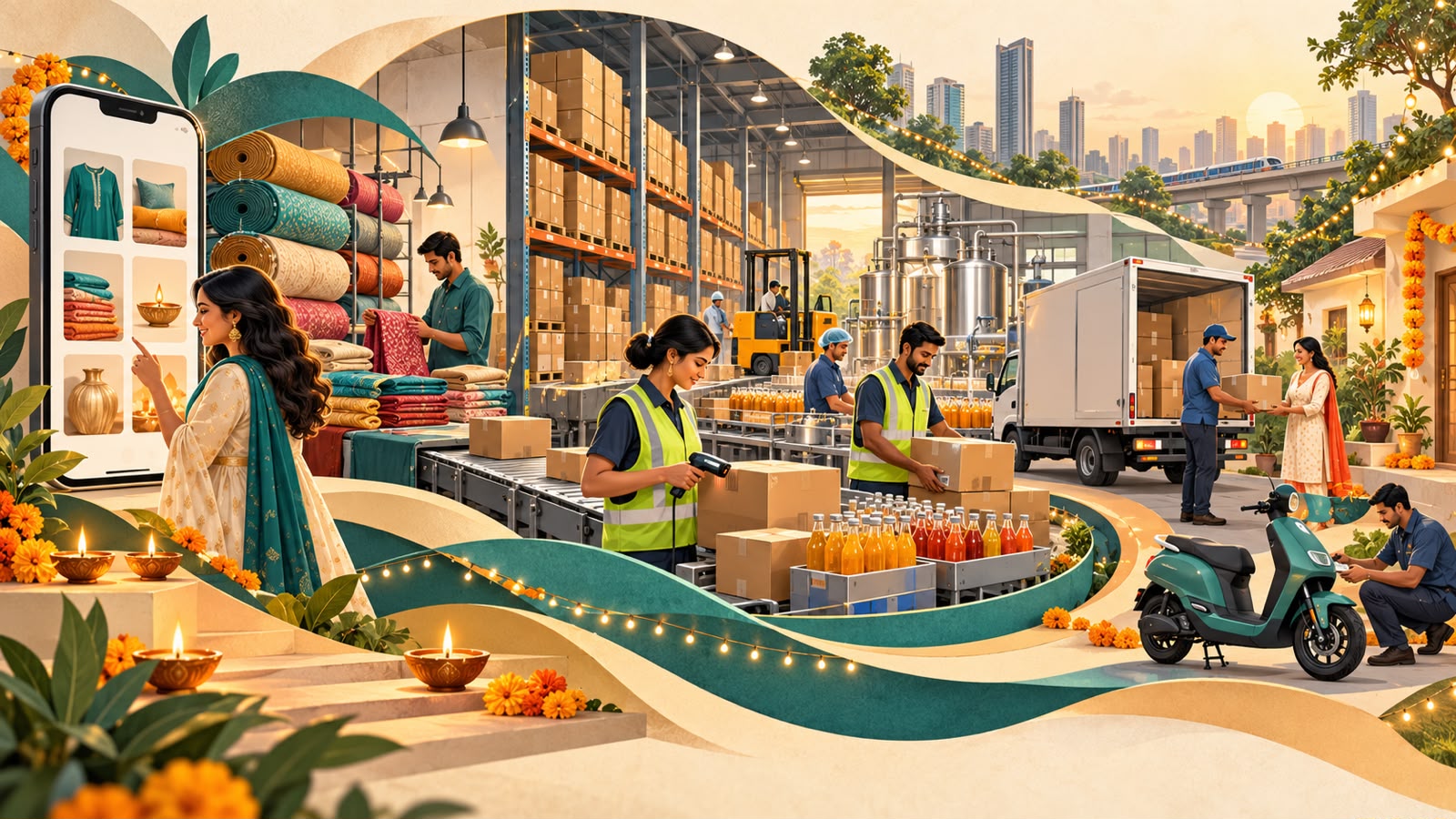
Behind every festive offer is a business preparing to deliver on it. Advertising may draw shoppers in, but turning that interest into a satisfying purchase depends on products being available, teams being ready, deliveries arriving as promised and service remaining accessible after the celebrations. As festive buying spreads across platforms, cities and a longer calendar, leaders across logistics, digital marketing, beverages, staffing and electric mobility explain how businesses are coordinating the people, operations and investments needed to serve the demand they create
Blue Dart reports a nearly 40–50% increase in shipment volumes against its business-as-usual levels so far this festive season. Its experience provides an operational starting point for a wider discussion about where purchases originate, how products reach customers and what businesses must deliver after the transaction.
Dipanjan Banerjee, Chief Commercial Officer, Blue Dart, said, "Today, festive logistics has moved beyond preparing for a brief spike in demand. It is now about managing a longer, more geographically dispersed consumption cycle driven by the continued growth of e-commerce, D2C, and social commerce.With big brands, MSMEs, and regional businesses increasingly looking to imporve their customer touchpoints across Tier II and Tier III markets, logistics has taken an even more prominent position in India's festive economy.
The festive season is already underway and, so far at Blue Dart, we have witnessed a nearly 40-50% jump in shipment volumes compared to our business-as-usual levels, driven by strong demand across e-commerce, D2C and social commerce segments. As shopping activity extends through the Diwali season and into upcoming events such as Black Friday, capacity planning, network readiness and operational agility remain critical to effectively support evolving demand patterns across markets.
Consumers and businesses today also expect greater delivery certainty. While speed remains important, factors such as time-definite deliveries, real-time shipment visibility and consistent service quality across locations are becoming equally critical. Advanced forecasting and network intelligence enable logistics providers to proactively identify bottlenecks and maintain service reliability during peak demand periods. As festive commerce reaches new markets and spans a longer duration, the ability to anticipate demand, adapt operations and deliver consistently will be as important as the scale of capacity deployed."
While logistics networks prepare to fulfil festive demand, brands are rethinking where and how advertising can turn consumer interest into purchases. Nitin Kumar Kosari, Business Head – eMarkets, LS Digital, said, “The biggest shift this festive season is that commerce is no longer sitting at the end of the media funnel; it is increasingly shaping the media plan itself. Brands are becoming more deliberate about where the next rupee of festive investment can create incremental revenue. While marketplaces continue to attract high-intent demand, quick commerce is emerging as a growth channel for last-minute purchases, gifting, hosting and impulse-led consumption. Retail media is further accelerating this shift, with brands moving from simply buying visibility to looking at search, sponsored placements, DSP and audience-led activation to influence consumers closer to the point of purchase. Our 2025 festive data reflects this evolution: marketplace and quick-commerce ad spends grew 16% YoY, while D2C spends declined by around 10%, with marketplace conversion improving from 4.4% to 6.1%.
For the 2026 festive season, we expect incremental budgets to increasingly move towards platforms and formats that can demonstrate measurable commerce outcomes. At the same time, brands are recognising that media cannot fix a weak digital shelf - inventory, pricing, assortment, content, ratings and conversion readiness need to come first. The festive planning conversation is therefore shifting from ‘How much should we spend?’ to ‘Where can the next rupee create the highest incremental commerce?’ - and that is where the real transformation is happening.”
Businesses are also contextualising consumerism patterns across online and offline channels into consideration to ensure success during festive season and beyond. Smita Jhanwar, Chief Financial Officer, Mafatlal Industries “The festive season serves as valuable indicator of consumer sentiment and the state of the apparel and textile industry. For consumers, festive buying remains relevant; however, their consumption behaviour is changing. Consumers have grown more conscious about value but that does not mean that they are spending less money; rather, they are making more informed decisions when it comes to quality, design, utility and price. Businesses can take advantage of this trend through understanding the changes in consumption habits and offering new products that meet consumers’ expectations.
The retail environment is also witnessing significant structural change because digital platforms are changing product search, engagement and access to markets even though the importance of physical retail remains. The gap between online and offline is no longer relevant. What matters is the integration of experience across different channels. For this reason, businesses need to be able to respond promptly to changes in demand, manage their inventory better, and adapt to new trends in the market.
Beyond the festive season, the industry's growth will increasingly be shaped by its ability to combine consumer insight with operational discipline and scalable business models. In a market as diverse as India, long-term competitiveness will depend not merely on capturing seasonal deman but on building businesses that can anticipate changing consumption patterns, deliver sustained value and translate market opportunities into profitable, long-term growth”
Reaching a buyer is one part of the task; however, ensuring that products are available when and where they are wanted requires preparation across the value chain. Avinash Kant Kumar, Head of Integrated Supply Chain, Hindustan Coca-Cola Beverages (HCCB), said, "Festivals are an integral part of India's consumer landscape, bringing distinct demand patterns across markets, channels, and occasions. For a beverage company, preparing for these peaks begins months in advance, with teams across planning, manufacturing, logistics, and distribution working together to anticipate demand and ensure readiness across the value chain. Our focus remains on staying agile, executing seamlessly, and leveraging investments in manufacturing and supply chain capabilities so that consumers can find their favourite beverages within easy reach as they come together to celebrate."
Delivering on these supply-chain plans also depends on having enough people with the right skills to manage peak demand. As businesses expand into smaller cities, workforce planning becomes central to keeping fulfilment operations running smoothly. Shailesh Khanna, Business Leader, ManpowerGroup India, said, “During festive season, there is a surge in the demand for flexi-talent especially in quick-commerce, e-commerce, and retail domains due to the load of orders and fast fulfillment cycles. Talent availability is critical as more emphasis is laid on the preparedness of the workforce. Employers are more interested in candidates who can keep up with technologies like inventories management systems, digital scanners, and fulfillment platforms.
When businesses move into Tier 2 and emerging markets, the need for talent with the requisite salary and ability to mobilize workers in an efficient manner during the peak loads will be more pressing for them. Having a comprehensive workforce strategy by incorporating flexible staffing solutions with the necessary skills will be very important for the employers in maintaining operational efficiency during the peak seasons and offering customers a good experience.”
For purchases that become part of everyday household life, readiness also includes financing, product guidance and service after the sale. Hemant Kabra, Founder, BGauss, said, “The festive season remains an important purchase window for Indian households. For families considering a new two-wheeler, the decision goes beyond festive offers to what the vehicle will deliver every day dependable performance, affordable running costs and convenient service support. Electric two-wheelers accounted for 11.6% of India’s two-wheeler retail sales in September 2026, according to FADA data, reflecting their growing acceptance. The festive season offers an opportunity to build on this momentum by helping buyers understand how an electric vehicle fits their daily commute, charging arrangements and household budget.
We expect the season to bring more first-time EV buyers into showrooms. For manufacturers, the responsibility is to make that transition reassuring through reliable products, accessible financing and responsive after-sales service. The confidence we build after the purchase will matter just as much as the festive sale itself.”
Ultimately, the festive season tests how well a business can turn preparation into a dependable customer experience. Advertising brings demand, but product availability, a prepared workforce, reliable delivery and responsive service determine how successfully that demand is met. For businesses, the lasting value of these investments extends beyond peak-season sales: getting the experience right can build customer confidence and give people a reason to return long after the offers have ended.